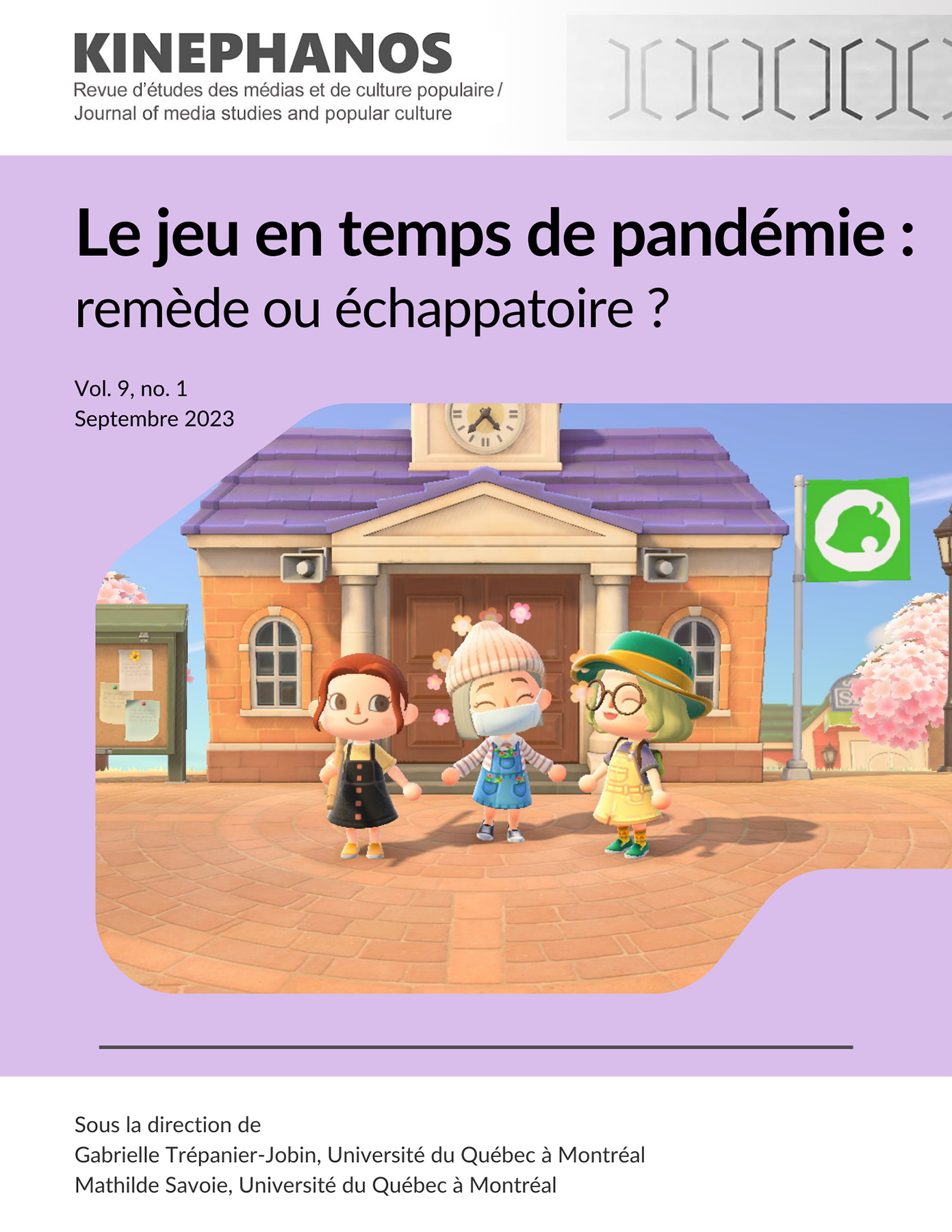
Créativité et réflexivité dans Animal Crossing: New Horizons
Quand la situation « en jeu » constitue un remède à la situation pandémique « hors jeu »
Mots-clés :
animal crossing: new horizons, pandémie, autoethnographie, design, créativité, réflexivité, pragmatismeRésumé
Cet article montre que les jeux de construction, tels qu’Animal Crossing: New Horizons, sont des activités de design faisant appel à un agir créatif qui constitue un « remède » face à des situations difficiles comme celle de la pandémie de COVID-19. Pour ce faire, il s’appuie sur une vision pragmatiste de la créativité en design, articulée autour du concept de « situation » provenant des travaux de Donald Schön et d’Hans Joas. Suivant une approche autoethnographique, l’auteure explique comment Animal Crossing: New Horizons lui a permis d’être créative et réflexive durant le confinement.
Références
ANDERSON L. & AUSTIN M. (2012), « Auto-ethnography in leisure studies », Leisure Studies, vol. 31, n°2, p. 131-146.
BANKS J. A. (2013), Co-creating Videogames, London, UK, Bloomsbury Academic.
BARNABÉ F. (2017), Rhétorique du détournement vidéoludique. Le cas de Pokémon, (thèse de doctorat), Université de Liège.
BECK J. & CHIAPELLO L. (2018), « Schön’s Intellectual Legacy: A Citation Analysis of DRS Publications (2010-2016) », Design Studies, vol. 56, p. 205-224.
BONENFANT M. & TRÉPANIER-JOBIN G. (2018), « Effets spéciaux dans les machinimas : le trucage des représentations vidéoludiques », Écranosphère, n°3, p. 142-169.
BOUDREAU K. (2012), Between Play and Design: The Emergence of Hybrid-Identity in Single-Player Videogames, (thèse de doctorat), Université de Montréal.
BOUSBACI R. (2008), « "Models of Man" in Design Thinking: The "Bounded Rationality" Episode », Design Issues, vol. 24, n°4, p. 38-52.
BUCHANAN R. (1992), « Wicked Problems in Design Thinking », Design Issues, vol. 8, n°2, p. 5-21.
CASAKIN H. P. (2007), « Metaphors in Design Problem Solving: Implications for Creativity », International Journal of Design, vol. 1, n°2, p. 23-35.
CHIAPELLO L. (2017), « Epistemological Underpinnings in Game Design Research », in P. Lankoski & J. Holopainen (dirs.), Game Design Research: An Introduction to Theory & Practice, Pittsburgh, ETC. Press, p. 15-33.
CMENTOWSKI S. & KRÜGER J. (2020), « Playing With Friends – The Importance of Social Play During the COVID-19 Pandemic », Extended Abstracts of the 2020 Annual Symposium on Computer-Human Interaction in Play, Canada, Association for Computing Machinery.
COMERFORD C. (2020), « Coconuts, Custom-Play & COVID-19: Social Isolation, Serious Leisure and Personas in Animal Crossing: New Horizons », Persona Studies, vol. 6, n°2, p. 101-117.
CROSS N. (1981), « The coming of post-industrial design », Design Studies, vol. 2, n°1, p. 3-7.
CROSS N. (2011), Design Thinking, Oxford, Berg.
DETERDING S. (2017), « The Pyrrhic Victory of Game Studies: Assessing the Past, Present, and Future of Interdisciplinary Game Research », Games and Culture, vol. 12, n°6, p. 521-543.
DEWEY J. (1938), Logic: The theory of inquiry, New York, Holt, Rinehart & Winston.
ELISONDO R. C. & MELGAR M. F. (2020), « Everyday Creativity in Times of COVID-19: A Qualitative Study from Argentina », Creativity. Theories–Research-Applications, vol. 7, n°2, p. 230-250
ELLIS C., ADAMS T. E. & BOCHNER A. P. (2011), « Autoethnography: an overview », Historical social research, vol. 36, n°4, p. 273-290.
ELLISON M. & DREW C. (2020), « Using Digital Sandbox Gaming to Improve Creativity Within Boys’ Writing », Journal of Research in Childhood Education, vol. 34, n°2, p. 277-287.
FRUSHTICK R. (2020), Animal Crossing New Horizons guide: second week walkthrough, https://www.polygon.com/animal-crossing-new-horizons-switch-acnh-guide/2020/3/27/21196990/second-week-daily-goals-walkthrough-how-to-unlock-clothing-shop-unlocks-steps (dernière consultation 28 mars 2023).
GALLE P. (2011), « Foundational and Instrumental Design Theory », Design Issues, vol. 27, n°4, p. 81-94.
GANDOLFI E. & GANDOLFI S. (2021), « Playing across the social zone-Animal Crossing, gaming communities and connectedness in a time of crisis », Academicus International Scientific Journal, vol. 23, p. 41-51.
GLĂVEANU V. P. (2010), « Paradigms in the study of creativity: Introducing the perspective of cultural psychology », New Ideas in Psychology, vol. 28, n°1, p. 79-93.
GREEN G. & KAUFMAN J. C. (dirs.) (2015), Video games and creativity, Amsterdam, Elsevier Academic Press.
HOMO LUDENS (2023), « Usages et appropriations du jeu vidéo Animal Crossing: New Horizons en contexte de pandémie », Kinephanos. Le jeu en temps de pandémie : remède ou échappatoire ?, vol. 9, n°1, p. 37-75.
HALL J., STICKLER U., HERODOTOU C. & IACOVIDES I. (2019), « Player conceptualizations of creativity in digital entertainment games », Convergence, vol. 26, n°5-6, p. 1226-1247.
HERNÁNDEZ R. J., COOPER R., TETHER B. & MURPHY E. (2018), « Design, the Language of Innovation: A Review of the Design Studies Literature », She Ji. The Journal of Design, Economics, and Innovation, vol. 4, n°3, p. 249-274.
JOAS H. (1999 [1992]), La créativité de l’agir, Paris, Les Éditions du Cerf.
JOAS H. & KILPINEN E. (2006), « Creativity and Society », in J. R. Shook & J.Margolis (dirs.), A Companion to Pragmatism, Oxford, Blackwell Publishing, p. 323-335.
JOHANSSON-SKÖLDBERG U., WOODILLA J. & ÇETINKAYA M. (2013), « Design Thinking: Past, Present and Possible Futures », Creativity and Innovation Management, vol. 22, n°2, p. 121-146.
JONES J. C. (1992), Design methods [1980], New York, John Wiley & Sons.
KAPOOR H. & KAUFMAN J. C. (2020), « Meaning-Making Through Creativity During COVID-19 », Frontiers in Psychology, vol. 11, p. 1-8.
KUITTINEN J. & HOLOPAINEN J. (2009), « Some notes on the nature of game design », Digital Games Research Association 2009 Conference: Breaking New Ground, Brunel University, Londres.
KULTIMA A. (2015), « Game Design Research », AcademicMindTrek'15, Tampere, Finlande.
LEWIS J. E., TROJOVSKY M. & JAMESON M. M. (2021), « New Social Horizons: Anxiety, Isolation, and Animal Crossing During the COVID-19 Pandemic », Frontiers in Virtual Reality, vol. 2, n°14, p. 1-7.
LIN X. & SU S. (2020), « Motivating Learning by Playing Animal Crossing New Horizons: A trending game during the COVID-19 pandemic », eLearn, vol. 2020, n°11, p. 1-8.
MERCIER M., VINCHON F., PICHOT N., BONETTO E., BONNARDEL N., GIRANDOLA F. & LUBART T. (2021), « COVID-19: A Boon or a Bane for Creativity? », Frontiers in Psychology, vol. 11, p. 1-10.
NINTENDO. (2020), Fiscal Year Ended March 2020 Financial Results Explanatory Material, https://www.nintendo.co.jp/ir/pdf/2020/200507_3e.pdf (dernière consultation 28 mars 2023).
OSBORN A. F. (1953), Applied Imagination: Principles and Procedures of Creative Thinking reference, New York, Scribners.
PUCCIO G. J. & CABRA J. F. (2010), « Organizational creativity », in J.C. Kaufman & R.J. Sternberg (dirs.), The Cambridge Handbook of Creativity, Cambridge, MA, Cambridge University Press, p. 145-173.
RICHARDS R. (2010), « Everyday Creativity », in J.C. Kaufman & R.J. Sternberg (dirs.), The Cambridge Handbook of Creativity, Cambridge, MA, Cambridge University Press, p. 189-215.
RITTEL H. W. & WEBBER M. M. (1973), « Dilemmas in a general theory of planning », Policy Sciences, vol. 4, n°2, p. 155-169.
SCHÖN D. (1983), The Reflective Practitione: How Professionals Think in Action, New York, Basic Books.
SCHÖN D. (1992a), « Designing as reflective conversation with the materials of a design situation », Research in Engineering Design, vol. 3, n°3, p. 131-147.
SCHÖN D. (1992b), « The theory of inquiry: Dewey’s legacy to education », Curriculum inquiry, vol. 22, n°2, p. 119-139.
SCULLY-BLAKER R. & FLYNN-JONES E. (2020), « Animal Crossing Special Issue Foreword », Loading..., vol. 13, n°22, p. 1-6.
SIMON H. A. (2004 [1969), Les sciences de l’artificiel, Paris, Gallimard.
ZHU L. (2021), « The psychology behind video games during COVID-19 pandemic: A case study of Animal Crossing: New Horizons », Human Behavior and Emerging Technologies, vol. 3, n°1, p. 157-159.
Téléchargements
Publié
Numéro
Rubrique
Licence

Cette œuvre est sous licence Creative Commons Attribution - Pas d'Utilisation Commerciale - Pas de Modification 4.0 International.