Affronter le confinement grâce à la modalisation des défilés de RuPaul’s Drag Race dans Animal Crossing: New Horizons
Mots-clés :
jeu vidéo, pandémie, confinement, animal crossing: new horizons, modalisation, création, expression identitaire, interactions socialesRésumé
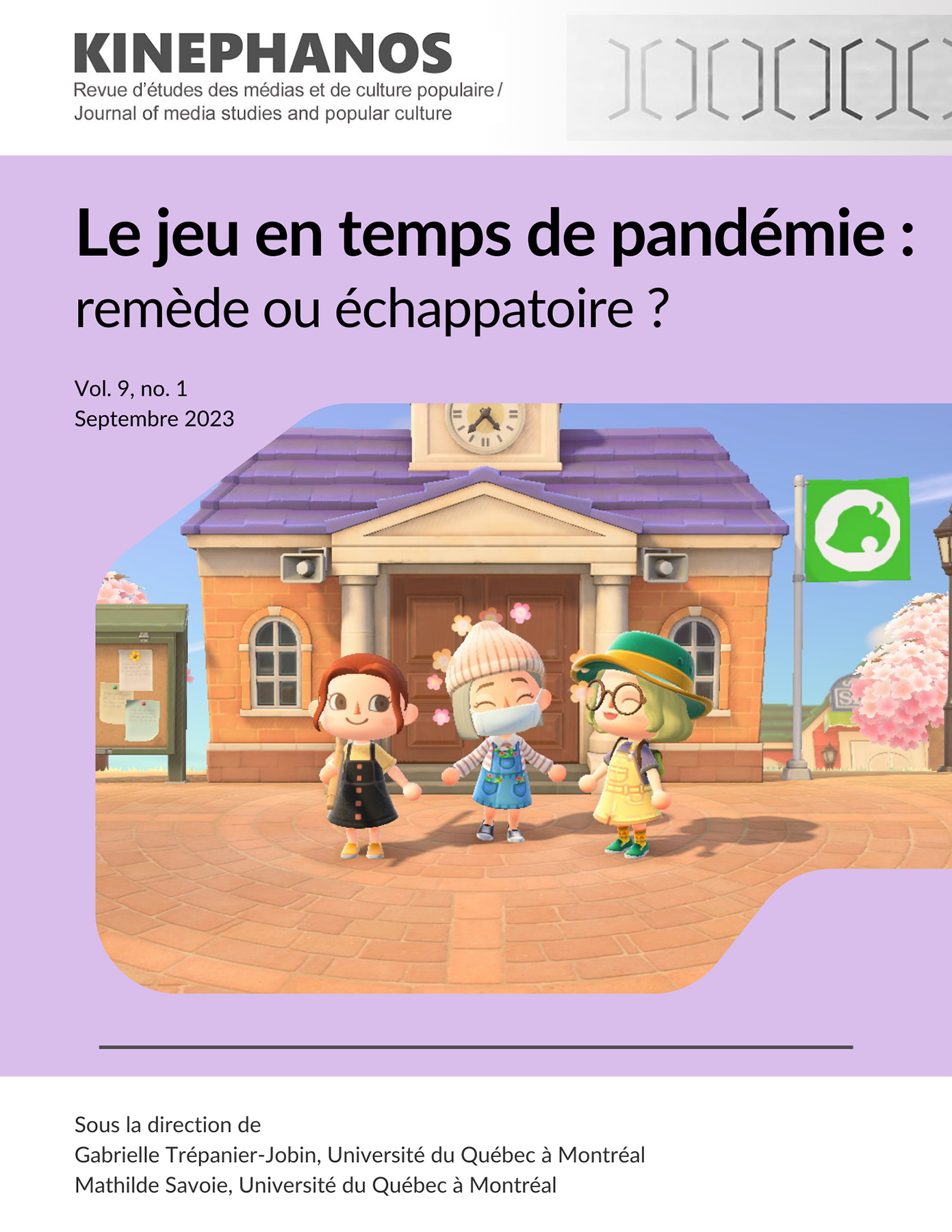
Le succès instantané que connut Animal Crossing: New Horizons au début de la pandémie, en mars 2020, incita plusieurs chercheur⋅se⋅s à se demander dans quelle mesure ce jeu servit, pour certain⋅e⋅s joueur⋅se⋅s, de remède aux désagréments causés par la pandémie, grâce à son environnement et son avatar modulables favorisant notamment la liberté de création, les interactions sociales et l’expression identitaire. Cet article illustre ces diverses fonctions positives jouées par AC:NH durant la pandémie et les paramètres du jeu qui les rendent possibles à partir d’une étude de cas, soit celle de l’organisation, par un joueur nommé Jou, d’un défilé en hommage à l’émission RuPaul’s Drag Race sur son île durant le confinement. Cette étude de cas s’appuie sur l’analyse de son récit phénoménologique et l’analyse du matériel produit durant l’évènement à la lumière de la théorie des cadres de Goffman et des théories sur la performance de Goffman et Butler.
Références
BARLATIER P.-J. (2018), « Chapitre 7. Les études de cas », in F. Chevalier, L. Martin Cloutier et N. Mitev (dirs.), Les méthodes de recherche du DBA, Caen, EMS Editions, p. 126-139.
BARTLE R. (1996), « Hearts, Clubs, Diamonds, Spades: Players Who Suit MUDs », The Journal of Virtual Environments, vol. 1, n°1.
BARR M. et COPELAND-STEWART A. (2021), « Playing Video Games During the COVID-19 Pandemic and Effects on Players’ Well-Being », Games and Culture, vol 17, n°1, p. 122-139.
BONENFANT M. (2015), Le libre jeu. Réflexions sur l’appropriation de l’activité ludique, Montréal, Liber.
BUTLER J. (2005 [1990]), Trouble dans le genre : le féminisme et la subversion de l’identité, Paris, Éditions La Découverte.
CHIAPELLO L. (2023), « Créativité et réflexivité dans Animal Crossing: New Horizons. Quand la situation "en jeu" constitue un remède à la situation pandémique "hors jeu" », Kinephanos. Le jeu en temps de pandémie : remède ou échappatoire ?, vol. 9, n°1, p. 76-101.
CLARISSE R. (1986), « L’apéritif : un rituel social », Cahiers Internationaux de Sociologie, vol. 80, p. 53-61.
GOFFMAN E. (1991), Les cadres de l’expérience, Paris, Éditions de Minuit.
GOFFMAN E. (1973), La mise en scène de la vie quotidienne 1. La présentation de soi, Paris, Éditions de Minuit.
HOMO LUDENS (2023), « Usages et appropriations du jeu vidéo Animal Crossing: New Horizons en contexte de pandémie », Kinephanos. Le jeu en temps de pandémie : remède ou échappatoire ?, vol. 9, n°1, p. 37-75.
LALLEMENT E. (2020), « From Bal Masques to Masked Balls: Festivity in the Era of Social Distancing », Journal of festive studies, vol. 2, n°1, p. 32-40.
LEWIS J. E., TROJOVSKY M. et JAMESON M. M. (2021), « New Social Horizons: Anxiety, Isolation, and Animal Crossing During the COVID-19 Pandemic », Frontiers in Virtual Reality, vol. 2.
NTEBUTSE J.-G. et CROYERE N. (2016), « Intérêt et valeur du récit phénoménologique : une logique de découverte », Recherche en soins infirmiers, vol. 1, n°124, p. 28-38.
MILLET C. (2019), Le côté obsqueer d’Animal Crossing, https://simonae.fr/articles/cote-bsqueer-animal-crossing#lien17 (dernière consultation 28 mars 2021).
PEARCE K. E., YIP J. C., LEE H. J, MARTINEZ J. J., WINDLEHARTH T. W., BHATTACHARYA, A. et LI, Q. (2021), « Families Playing Animal Crossing Together: Coping With Video Games During the COVID-19 Pandemic », Games and Culture, vol. 17, n°5, p. 1-22.
TAYLOR T. L. (2002), « Living Digitally: Embodiment in Virtual Worlds », in R. Schroeder (Ed.), The Social Life of Avatars: Presence and Interaction in Shared Virtual Environments, London, Springer-Verlag, p. 40-62.
TRÉPANIER-JOBIN G. (2013), « Le cyberthéâtre des identités : performances et performativité du genre dans les environnements numériques », in R. Bourassa & L. Poissant (dirs.), Avatars, personnages et acteurs virtuels, Québec, Presses de l’Université du Québec, p. 195-224.
Téléchargements
Publié
Numéro
Rubrique
Licence

Cette œuvre est sous licence Creative Commons Attribution - Pas d'Utilisation Commerciale - Pas de Modification 4.0 International.