Le paradoxe de la réclusion heureuse en temps de confinement
Design d’environnement et claustrophilie dans Animal Crossing: New Horizons
Keywords:
video game, lockdown, environmental design, animal crossing: nhew horizonsAbstract
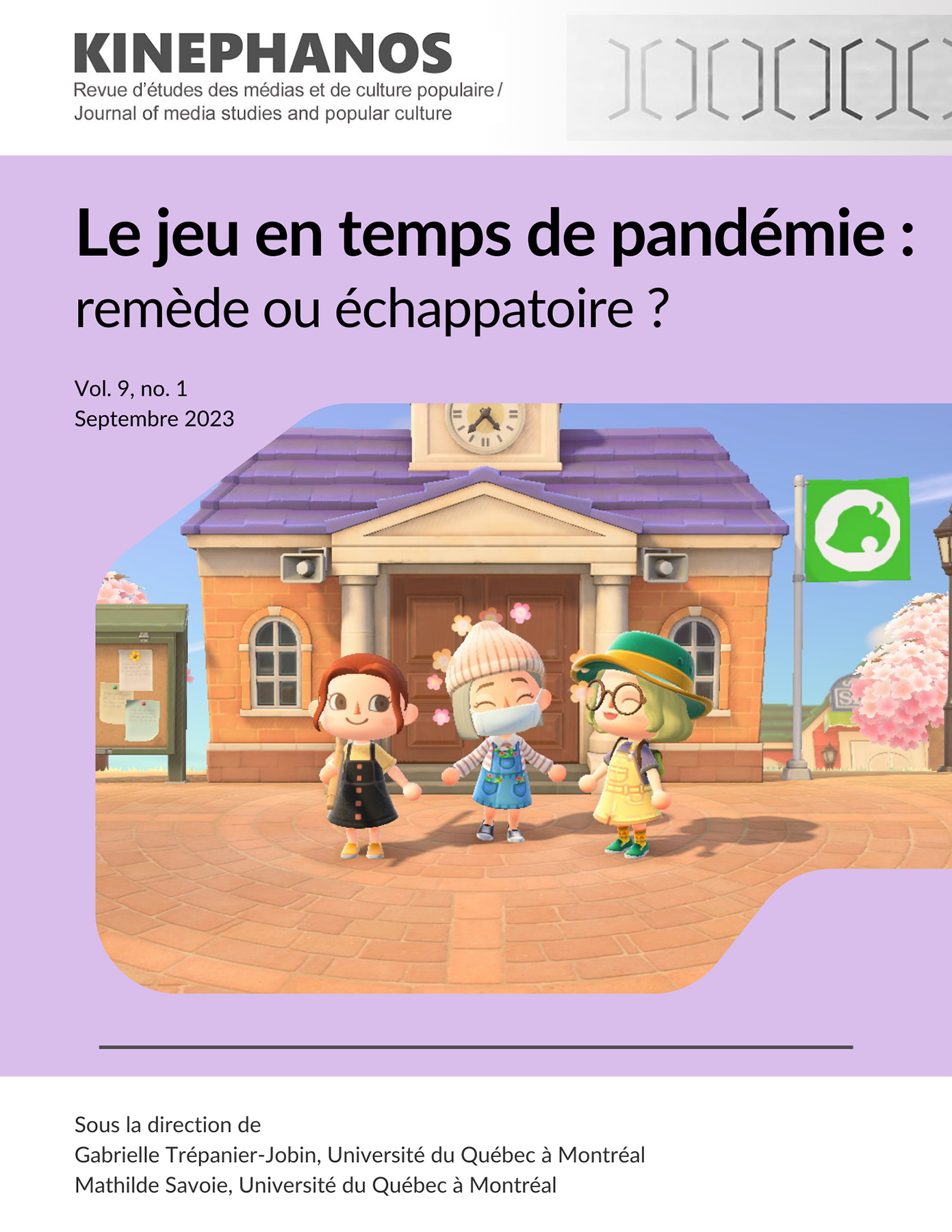
Game studies have long considered the navigable space of video games through the lens of compensation, as if they were filling an “appetite for space” frustrated by our contemporaryurban lifestyles. In this article, we challenge this psycho-cultural function of video games in light of the phenomenal success of the game Animal Crossing: New Horizons during the lockdown associated with the COVID-19 pandemic. At a time when our relationship to space was more in crisis than ever, and when navigational constraints were at their height, players favored a playful space that seems the exact opposite of open worlds. To explain how this game’s space has been invested by the players during this period, we conduct an analysis of its environment design based on four concepts: the idea of space-refuge, of microcosmic, of cosmetics, and, finally, of an anti-critical path. Through descriptions of its environment design and annotated maps, we show how Animal Crossing: New Horizons has transfigured the everyday experience of seclusion more than conjuring it, therefore challenging the theories which depict the evolution of video game spatiality as a movement “from the closed world to the infinite universe.”
References
AARSETH E. (2005), « From Hunt the Wumpus to EverQuest: Introduction to Quest Theory », in F. Kishino, Y. Kitamura, H. Kato & N. Nagata (dir.), Proceedings of the Entertainment Computing - ICEC 2005, vol. 3711, p. 496 506.
AARSETH E. (2001), « Allegories of Space. The Question of Spatiality in Computer Games ». Zeitschrift für Semiotik, vol. 23, n°3 4, p. 152 171.
AARSETH E. (1997), Cybertext: Perspectives on Ergodic Literature, Baltimore, JHU Press.
AARSETH E. & GÜNZEL S. (dir.) (2019), Ludotopia: spaces, places and territories in computer games, Bielefeld, Transcript Verlag.
AURAY N. & VÉTEL B. (2013), « L’exploration comme modalité d’ouverture attentionnelle. Design et régulation d’un jeu freemium », Réseaux, vol. 182, p. 153 186.
BACHELARD G. (1957), La poétique de l’espace, Paris, Presses universitaires de France.
BAYCHELIER G. (2020), « Imaginaires des espaces clos dans les jeux vidéo horrifiques : cellules, sanctuaires et spatialités dynamiques », in D. Gachet, F. Plet-Nicolas & N. V. Deyres (dir.), Voyages intérieurs et espaces clos dans les domaines de l’imaginaire (littérature, cinéma, transmédias), XIXe-XXIe siècles, Le Fil à retordre, n°1, Université Bordeaux Montaigne.
BONENFANT M., TRÉPANIER-JOBIN G. & LAFRANCE ST-MARTIN L. I. (2020), « L’approche communicationnelle en études du jeu : un apport des chercheur.se.s de la Faculté de communication de l’UQAM ». Communiquer. Revue de communication sociale et publique, Volume hors série : La communication à l’UQAM, p. 77 102.
CALLEJA G. (2011), In-game: from immersion to incorporation, Cambridge, MA, The MIT
Press
FLYNN B. (2008), « The Navigators Experience - An Examination of the Spatial in Computer Games », in M. Swalwell & J. Wilson (dir.), The pleasures of computer gaming: essays on cultural history, theory and aesthetics, Jefferson, McFarland & Co, p. 118 146.
FRICHE L. (2020), Analyser le rapport entre le joueur et l’espace de jeu par la cartographie Etude de l’interface de carte, ses attributs, et leurs rapports dans la formalisation de l’éthos ludique, mémoire de maîtrise, Université de Lorraine.
FULLER M. & JENKINS H. (1995), « Nintendo® and New World Travel Writing: A Dialogue », in S. G. Jones (dir.), Cybersociety: Computer-Mediated Communication and Community, Thousand Oaks, Sage Publications, p. 57 72.
GAMECENTRAL (2020), « Best-selling video game of 2020 is FIFA 21, Persona 5 Royal is highest rated », Metro, https://metro.co.uk/2020/12/23/best-selling-video-game-of-2020-is-fifa-21-persona-5-is-highest-rated-13796429/ (dernière consultation le 29 août 2023).
GAZZARD A. (2013), Mazes in Videogames: Meaning, Metaphor and Design, Jefferson, McFarland & Co.
GENVO S. (2016), « Defining and Designing Expressive Games: the case of Keys of a gamespace », Kinephanos, Special issue: Exploring the Frontiers of Digital Gaming: Traditional Games, Expressive Games, Pervasive Games, p. 90-106.
GRANDJEAN G. (2020), Le langage du level design : analyse communicationnelle des structures et instances de médiation spatiales dans la série The Legend of Zelda (1986-2017), https://hal.univ-lorraine.fr/tel-03098076/document (dernière consultation le 29 août 2023).
GRANDJEAN G. (2019), « Analyse formelle et visuelle de l’organisation des espaces sociaux vidéoludiques », Emulations - Revue de sciences sociales, no30, p. 33 48.
GRUBB J. (2021), « NPD reveals the best-selling games of 2020 in the U.S », VentureBeat. https://venturebeat.com/2021/01/15/npd-reveals-the-best-selling-games-of-2020-in-the-u-s/ (dernière consultation le 29 août 2023).
HOMO LUDENS (2023), « Usages et appropriations du jeu vidéo Animal Crossing: New Horizons en contexte de pandémie », Kinephanos. Le jeu en temps de pandémie : remède ou échappatoire ?, vol. 9, n°1, p. 37-75.
IWATA S. AONUMA E. TAKIZAWA S. DOHTA T. & ARIMOTO M. (2013), « Iwatademande : The Legend of Zelda: The Wind Waker HD. 5. Trop ambitieux à l’époque ». https://www.nintendo.fr/Iwata-demande/Iwata-demande-The-Legend-of-Zelda-The-Wind-Waker-HD/The-Legend-of-Zelda-The-Wind-Waker-HD/5-Trop-ambitieux-a-l -epoque/5-Trop-ambitieux-a-l-epoque-807330.html (dernière consultation le 29 août 2023).
JENKINS H. (2006), « Complete Freedom of Movement: Video Games as Gendered Play Spaces », in K. Salen et E. Zimmerman (dir.), The Game Design Reader. A Rules of Play Anthology, Cambridge, MA, The MIT Press, p. 330 363.
JENKINS H. (2004), « Game design as narrative architecture », in P. Harrington & N. Frup-Waldrop (dir.), First Person: New Media as Story, Performance, and Game, Cambridge, MA, MIT Press, p. 118 130.
JENKINS H. & SQUIRE K. D. (2002), « The art of contested spaces », in C. Bain C. & L. Kings (dir.), Game On: The History and culture of video games. Barbican Press, p. 64 75.
KOYRÉ A. (1973), Du monde clos à l’univers infini, Paris, Gallimard.
KREMERS R. (2009), Level design: concept, theory, and practice, Natick, A.K. Peters.
MACLEAN C. (2020). « Animal Crossing New Horizons : Nintendo prévoit de sévir contre le marché noir », Parler de sport. La perspective des fans, https://parlersport.com/animal-crossing-new-horizons-nintendo-prevoit-de-sevir-contre-le-marche-noir/ (dernière consultation le 29 août 2023).
MURRAY S. (2018), On Video Games: The Visual Politics of Race, Gender and Space. Londres, I. B. Tauris.
NITSCHE M. (2008), Video game spaces: image, play, and structure in 3D game worlds, Cambridge, MA, MIT Press.
PARBAUD C. (2021), « FIFA 21 est (encore) le jeu vidéo le plus vendu en France en 2020 », L’Équipe. https://www.lequipe.fr/Jeuxvideo/Actualites/Fifa-21-est-encore-le-jeu-video-le-plus-vendu-en-france-en-2020/1228701 (dernière consultation le 29 août 2023).
PEARCE C. (2007), « Narrative environments. From Disneyland to World of Warcraft », in F. V. Borries, S. P. Walz & M. Böttger (dir.), Space Time Play: Computer Games, Architecture and Urbanism: the Next Level, Basel, Birkhäuser, p. 200 205.
PEARCE C. (2002), « Story as play space: narrative in games », in L. King (dir.), Game On. The History and Culture of videogames, Londres, Laurence King Publishing Ltd, p. 112 119.
RUFAT, S. & TER MINASSIAN, H. (2012), « Espace et jeu vidéo », in S. Rufat & H. Ter Minassian (dir.), Le jeu vidéo comme objet de recherche, Paris, Questions théoriques, p. 77 103.
RYAN M.-L. (2014), « L’expérience de l’espace dans les jeux vidéo et les récits numériques », Cahiers de Narratologie, no27.
STOCKBURGER A. (2006), The Rendered Arena. Modalities of Space in Video and Computer
Games, thèse de doctorat, University of the Arts, London.
STOUT M. (2010), « Oblivion Exploration Analysis », On Game Design, http://www.ongamedesign.net/oblivion-exploration-analysis/ (dernière consultation le 29 août 2023).
STRAZNICKAS G. L. (2020), « Not Just a Slice: Animal Crossing and a Life Ongoing ». Loading..., vol. 13, no22, p. 72 88.
TER MINASSIAN H., RUFAT, S. & BORZAKIAN M. (2017), « Le jeu dans tous ses espaces », Sciences du jeu, no 8.
TOTTEN C. W. (2019), Architectural approach to level design, Boca Raton, CRC Press.
TRICLOT M. (2012), « Dedans, dehors et au milieu : les espaces du jeu vidéo », in H. Ter Minassian, S. Rufat & S. Coavoux (dir.), Espaces et temps des jeux vidéo, Paris, Questions théoriques, p. 207 235.
VELLA D. (2019), « There’s No Place Like Home. Dwelling and Being at Home in Digital Games », in E. Aarseth & S. Günzel (dir.), Ludotopia. Spaces, places and territories in computer games (p. 141 165), Bielefeld, Transcript Verlag.
VERCHÈRE R. (2019), « Gouverner le joueur dans les jeux vidéo : La métaphysique des "affordances" au service de la politique des "architectures du choix" ». Sciences du jeu, no11.
Downloads
Published
Issue
Section
License

This work is licensed under a Creative Commons Attribution-NonCommercial-NoDerivatives 4.0 International License.